Key Takeaways:
- The Right Tools Define Your Output: Quality carpenter tools improve speed, precision, and finish quality on every job.
- Material Selection Matters More Than Price: Titanium, milled steel, and engineered polymers can outlast budget alternatives when properly designed and manufactured.
- Professional Standards Save Time and Money: Tools built to job site standards can reduce replacements, downtime, and physical strain.
The difference between a carpenter who struggles and one who works clean usually comes down to one thing: the tools in their belt. Not talent. Not experience alone. The right tool for the right application, in good condition, ready to work. Show up without it, and you're improvising. Improvising costs time, accuracy, and the quality of the finished product.
At Martinez Tools, we build carpenter tools for tradesmen who work full days in demanding conditions, hammers, squares, layout tools, and specialty tools engineered to perform under real job-site conditions. American-made and built to a standard that holds up shift after shift.
In this piece, we'll cover a complete carpenter tools list across every skill level, from the basic tools every carpenter starts with to the professional-grade setup that serious tradesmen rely on, so you know exactly what belongs in your belt and what's worth investing in.
Why Smart Tradespeople Invest In Premium Tool Systems
Budget tools cost less upfront. They also may cost more long-term. Poorly made tools may crack, loosen, or fail under heavy use. Handle and component performance depend on material quality, design, and manufacturing. You replace them, re-buy, and lose time in between.
Premium carpenter tools are built differently. Materials are selected for durability and performance. Titanium can reduce tool weight while maintaining strength. Properly heat-treated steel withstands high-impact use. Balanced designs minimize fatigue during extended work.
Less Downtime, Fewer Replacements
A broken tool on-site stops the job. You drive to the supplier. You wait for the stock. You lose hours.
Tools built to professional standards can reduce interruptions and are more likely to withstand years of daily use when properly selected, used, and maintained.
Performance That Compounds Over Time
Small improvements add up. A lighter hammer reduces shoulder strain. A balanced pry bar improves leverage. A precise square speed layout works when used correctly and kept in good condition. Multiply those gains across hundreds of strikes, measurements, and pulls per day. The difference becomes measurable in output, in accuracy, and in how your body feels at the end of a shift.

The Complete Carpentry Tools List For Professional Tradesmen
Professional carpenters carry more than the basics. A dedicated rafter square tool speeds up pitch layout and plumb cut marking on roof framing without the math. The full toolkit includes:
Measuring and Layout
- 25' tape measure
- Speed square
- Stair gauge for repeat-angle framing and rafter layout
- Framing square
- Chalk line
- Laser level
Striking and Demolition
- 15oz titanium framing hammer
- 12oz finish hammer
- Titanium pry bars in multiple sizes
- Mallet for chisel work
Cutting
- Circular saw
- Miter saw
- Jigsaw
- Hand saw
- Chisel set
Fastening
- Cordless drill
- Impact driver
- Framing nailer
- Finish nailer
Finishing
- Block plane
- Sanding block
- Caulk gun
- Utility knife
Basic Carpenter Tools: Where Every Skill Level Starts
Every carpenter starts with the same foundation. Whether you're just getting started or filling in gaps in an existing setup, our Carpentry Tools List: 25 Must-Have Tools for Every Skill Level helps you inventory what you have and identify what's missing. These are the tools that show up on every job, at every skill level, in every trade. Get these right and everything else builds from there.
- Tape Measure — 25' minimum. Wide, stiff blade that holds on long pulls. Every layout decision starts here.
- Hammer — 16oz for general carpentry. Drives nails, pulls fasteners, and adjusts work. The most-used tool on any job site, get one that fits your hand and holds up to daily use. Choosing the best carpenter hammer for your grip style and daily volume is one of the most important early decisions you'll make.
- Carpenter Square — Marks and verifies right angles. Used for layout, cut lines, and checking assemblies. Needs to hold a true 90 degrees to be useful. A quality carpenter square should hold a true 90 degrees through daily use without requiring recalibration.
- Speed Square — Fast angle reference for 90-degree and 45-degree cuts. Compact enough to stay in your pouch and accurate enough for structural work.
- Utility Knife — Scores material, cuts housewrap, and handles a dozen tasks that don't warrant a saw. A sharp blade that stays sharp matters more than most carpenters account for.
- Chalk Line — Snaps long, straight reference lines across plates, subfloor, and sheathing. Essential for keeping layout on line across long runs.
- Level — 48" minimum for framing. Checks walls, posts, and headers for plumb and level before they get locked in. Catching it here is faster than correcting it after.
- Pencil and Keel — Pencil for detail marks. Keel for structural lumber where a pencil line disappears in sawdust. Both belong in every carpenter's pouch.

Upgrading To Professional Carpenter Tools For Production Work
Production work exposes every weakness in a tool setup. Here's what the upgrade looks like.
Framing Hammer: From Steel to Titanium
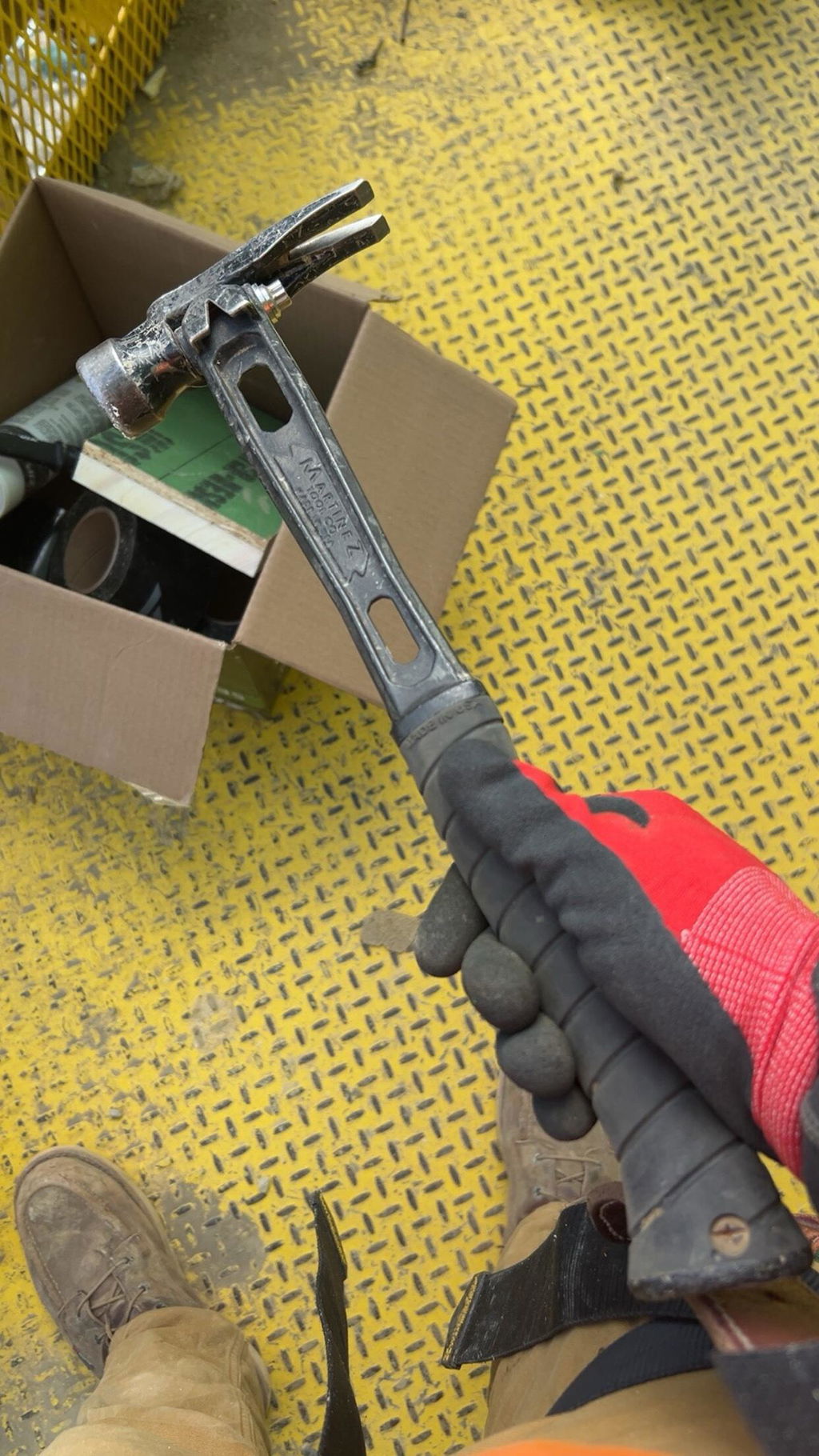
A steel hammer gets the job done at the entry level. On a production site, it wears you down before the day does. The Martinez M1, 15oz milled or smooth steel head on a 16" titanium handle, drives faster, transfers less vibration, and holds up through the volume of daily production work that destroys lesser tools by mid-season.
Layout Square: From Stamped to Precision Machined
A stamped aluminum square works for occasional use. Production framing demands a square that holds true 90 degrees under daily abuse. Martinez framing and rapid squares are precision-machined, not stamped, and built to maintain calibration through production-level use.
Pry Bar: From Hardware Store to Titanium
Steel bends under production load faster than most tradesmen expect. The Martinez titanium pry bar delivers the same leverage at a lower weight, without bending under the demands of daily framing and demolition work.
Stair Gauge: From Skip to Standard
The Martinez stair gauge clamps to a framing square and locks in consistent rise, run, rafter angles, and repeat-angle framing marks across every member, fast, accurate, and repeatable on production stair and rafter work. Stair gauges for framing squares turn a standard square into a repeatable layout system for production stair and rafter work.
Build Your Ultimate Setup With Martinez Tools Co. Gear
Martinez Tools builds one kind of tool: professional-grade. Every product in the lineup is American-made, precision-engineered, and built to withstand the daily demands of real job-site work. Not built to a price point. Built to a performance standard. Ordering direct from Martinez Tools means no middlemen and no retail markups. You're buying straight from the source, with better pricing, faster fulfillment, and direct access to people who know the product. Free shipping on every order within the United States, processed and out the door within 3–5 business days.
The tools in your belt say something about how seriously you take the work. Martinez Tools are built for tradesmen who take it seriously, framers, finish carpenters, and builders who invest in tools that earn their place and stay there. Shop the full Martinez lineup today and build a setup that holds up as long as your career does.

Final Thoughts
The carpenter tools you choose affect every job you take. Poorly made tools may fail prematurely. Heavy tools increase fatigue. Poorly designed tools slow you down. Professional-grade tools can perform better, last longer, and reduce physical strain. High-quality tools may reduce replacement-related downtime under heavy use, though actual savings depend on the tool, work conditions, maintenance, and purchase price.
Martinez Tools builds carpenter tools for tradesmen who depend on them. Every hammer, pry bar, and layout tool is engineered for job site performance. Materials are selected for durability. Balance is optimized to reduce fatigue. Construction methods prioritize function over cost. Invest in tools that work as hard as you do.
Frequently Asked Questions About Essential Carpenter Tools
What are the 15 common carpentry tools?
Tape measure, speed square, framing hammer, finish hammer, circular saw, hand saw, chisel set, cordless drill, impact driver, pry bar, level, chalk line, utility knife, miter saw, and framing square.
What are the skills needed in carpentry?
Reading blueprints, precise measuring and layout, safe tool operation, material selection, joinery techniques, and problem-solving on-site.
What is the 3/4/5 rule in carpentry?
A method for establishing square corners using a 3-foot measurement on one side, 4 feet on another, and confirming with a 5-foot diagonal. This derives from the Pythagorean theorem: 3² + 4² = 5².
Why is investing in quality hand tools better than buying cheap alternatives?
High-quality tools can last longer and reduce replacement-related downtime under heavy use, but actual savings depend on the tool, work conditions, maintenance, and purchase price.
How do I maintain my tools to ensure they last for years of daily job-site use?
Clean debris after each use, store in dry conditions, sharpen blades regularly, check fasteners for tightness, and replace worn grips before they fail.
Should I prioritize hand tools or power tools when building my initial toolkit?
Start with essential hand tools, hammer, tape measure, square, hand saw, then add power tools as job requirements and budget allow.