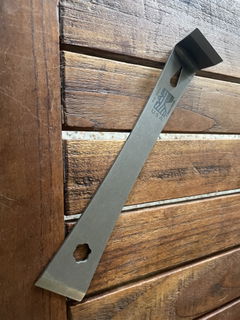
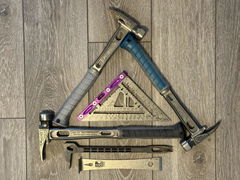
A rafter square is a layout tool that marks angles, checks square, and calculates cuts for roof framing. Triangular in shape, typically 7 to 12 inches on the longest edge, with degree markings and rafter-layout scales on the face.
Marking Rafter Cuts
The primary use is laying out common, hip, and valley rafters. The scales correspond to standard roof pitches — 4/12, 6/12, 8/12, and so on. Align the square with the lumber, use the appropriate scale, and mark your plumb cut, seat cut, or bird's mouth.
General Framing Layout
Beyond roofing, a rafter square handles any repetitive angle work — cutting studs, marking joists, checking corners. The 90-degree edge lets it double as a quick-reference square on any layout task.
Reading Built-In Scales
Most professional rafter squares include common and hip/valley scales, with some providing rafter-length reference information. Reference the pitch on the tool, read the multiplier. Faster than paper math and eliminates calculation errors on site.
How An Inaccurate Rafter Square Costs You Time And Material
An off-calibration rafter square doesn't just create one bad cut — it compounds across every layout mark you make.
Wasted Lumber
When cuts don't align, you re-cut or scrap the piece. On large projects, that adds up fast. Lumber costs money, and delays cost more.
Rework and Adjustment
Poorly marked rafters don't seat correctly. You spend extra time shimming, planing, or adjusting what should have fit the first time. Accuracy at layout eliminates rework.
Job Site Delays
Layout is the foundation of framing work. When it's wrong, everything after it suffers. The crew slows down and the schedule slips.
What To Look For In A Professional Rafter Square Tool
Cheap tools bend, fade, and lose accuracy after a few months on site. Here's what matters in a square built for professional use.
Material Durability
Titanium offers high strength and corrosion resistance, though performance depends on alloy, thickness, and design. Aluminum is lightweight and corrosion-resistant — suitable for general job-site layout use and the standard for most professional rafter squares.
Clear, Permanent Markings
Etched or laser-engraved markings are more durable than surface-printed ones. Visibility matters when you're reading measurements fast in dusty conditions or low light.
Edge Accuracy
The edges need to stay true. A rafter square that loses calibration or can't hold 90 degrees is a liability on the job site, not a tool.
The Best Rafter Square Tool For Framing And Roof Layout Work
Martinez Tools builds squares for professionals who lay out roofs, mark rafters, and work to a standard that doesn't leave room for error.
Martinez Rapid Square
Built for fast, repeatable angle work on the job site. Precision-machined, American-made, and built to hold calibration through daily use. Available in multiple blade configurations and fully customizable through the Martinez square configurator — choose your blade, color, and finish to build a square spec'd for the way you work. Browse the full rapid squares collection to compare every available configuration.
Martinez Large Framing Square
Built for structural layout work. The Martinez Large Framing Square gives you the reference edge you need for rafter layout, stair stringers, and large assembly checks — accurate, durable, and built to the same standard as every tool in the Martinez lineup. Browse the large framing squares collection for available configurations.
Build Your Custom Rapid Square
Martinez offers a full square configurator. Use the build your custom rapid square configurator to choose blade style, color, and finish and get a square built exactly the way you need it.
How Material And Calibration Affect Rafter Square Performance
Material and machining precision determine how well a rafter square performs — and how long it holds that performance under daily job-site use.
Aluminum is the standard: lightweight, corrosion-resistant, and durable enough for demanding conditions. Titanium takes it further — stronger than aluminum at a lighter weight, with better resistance to bending and warping under impact. For tradesmen who use their square every day, material is not a cosmetic choice. It's a performance one.
Calibration
A square not machined to a true 90 degrees is a liability, not a tool. Precision machining to tight tolerances ensures the reference angle is accurate from first use and stays accurate through the abuse of daily job-site work. Printed or stamped markings wear off. Engraved markings hold. Both matter when you're reading measurements fast.
Why Both Matter Together
The best material means nothing if the calibration is off. Perfect calibration means nothing if the material warps under use. A professional rafter square needs both — built to a standard that holds up as long as you're putting it to work.
Why Pros Choose Martinez For Their Rafter Square Tools
There's no shortage of rafter squares on the market. What's harder to find is one built to the standard professional roof framers actually need. Martinez builds squares for tradesmen who use them every day, and that difference shows in every design decision we make.
To see which rafter and layout square configurations professional tradesmen choose most, browse the best-selling squares collection before making a selection.
Precision Machined to a True Standard
Every Martinez square is machined to tight tolerances — not stamped, not cast. The 90-degree reference angle is built in from the start and stays accurate through daily job-site use.
American-Made From the Ground Up
Martinez squares are built in the USA. Consistent quality control, tighter manufacturing tolerances, and a finished product that performs to the same standard every time.
Customization Built Into the System
The Martinez square configurator lets you choose blade style, color, and finish — same precision, same American-made standard, configured the way you want it.
Shop The Martinez Rafter Square Tool Built For Precision Work
Precision-machined, American-made, and built to hold calibration through the demands of daily job-site use. Browse the Martinez rafter square lineup and order the configuration that fits your work, or use the custom square configurator to build one spec'd exactly to your layout style.
For tradesmen who want to compare every layout square option in the Martinez lineup, the full squares collection covers every format built to the same precision standard.
Order direct from Martinez Tools. Free shipping on every order within the United States, processed and out the door within 3–5 business days.