Key Takeaways:
- Match Tool to Task: Using the wrong hammer type decreases efficiency, damages materials, and increases fatigue on job sites.
- Framing vs. Finishing Defines Design: Framing hammers prioritize power and durability, while finishing hammers emphasize control and surface protection.
- Handle and Grip Matter as Much as Head: Long shifts demand materials that reduce shock, prevent slippage, and maintain comfort under repeated use.
The tool in your hand shapes the quality of the work it produces, and understanding which configuration matches your trade is the first step toward choosing right. Watch our guide on which Martinez hammer is right for me to find the head weight, handle, and face that fits your specific applications.
At Martinez Tools, we build hammers for tradesmen who understand that distinction. Every hammer in our lineup is purpose-built, engineered for a specific trade, application, and daily performance standard. We don't make general-purpose tools. We make the right tool for the job.
In this piece, we'll break down the most common hammer types, cover the key differences between framing and finishing hammers, walk through a practical hammer comparison guide, and help you match the right tool to your trade, so you stop settling and start working with what the job actually calls for.
Why Hammer Selection Matters
Ever watch a framer try to set trim with a 28-ounce straight-claw? Or a finish carpenter swing a waffle-face at crown molding? Wrong tool, wrong result. Typically, the wrong hammer choice shows up in three ways: damaged materials, wasted time, and physical fatigue. Using an oversized framing hammer for trim work leaves marks and splits wood. Using an undersized finishing hammer for framing slows production and requires more swings per fastener. Both scenarios increase labor costs and decrease job quality.
How Hammer Weight and Balance Affect Your Work
Head weight determines striking power, but balance determines efficiency. A poorly balanced hammer requires more effort per swing and increases arm fatigue. Properly balanced tools transfer energy efficiently, reducing the number of swings needed and minimizing strain on joints and muscles during extended use.
What Professional Tradesmen Look for in a Hammer
Professionals evaluate hammers based on performance criteria: head weight appropriate to the task, face design matched to fastener type, claw geometry suited to pulling nails, handle material that dampens shock, and overall build quality that withstands daily abuse. They don't buy tools based on marketing claims. They buy based on how the tool performs on-site.

Types Of Hammers For Construction And What Each One Does
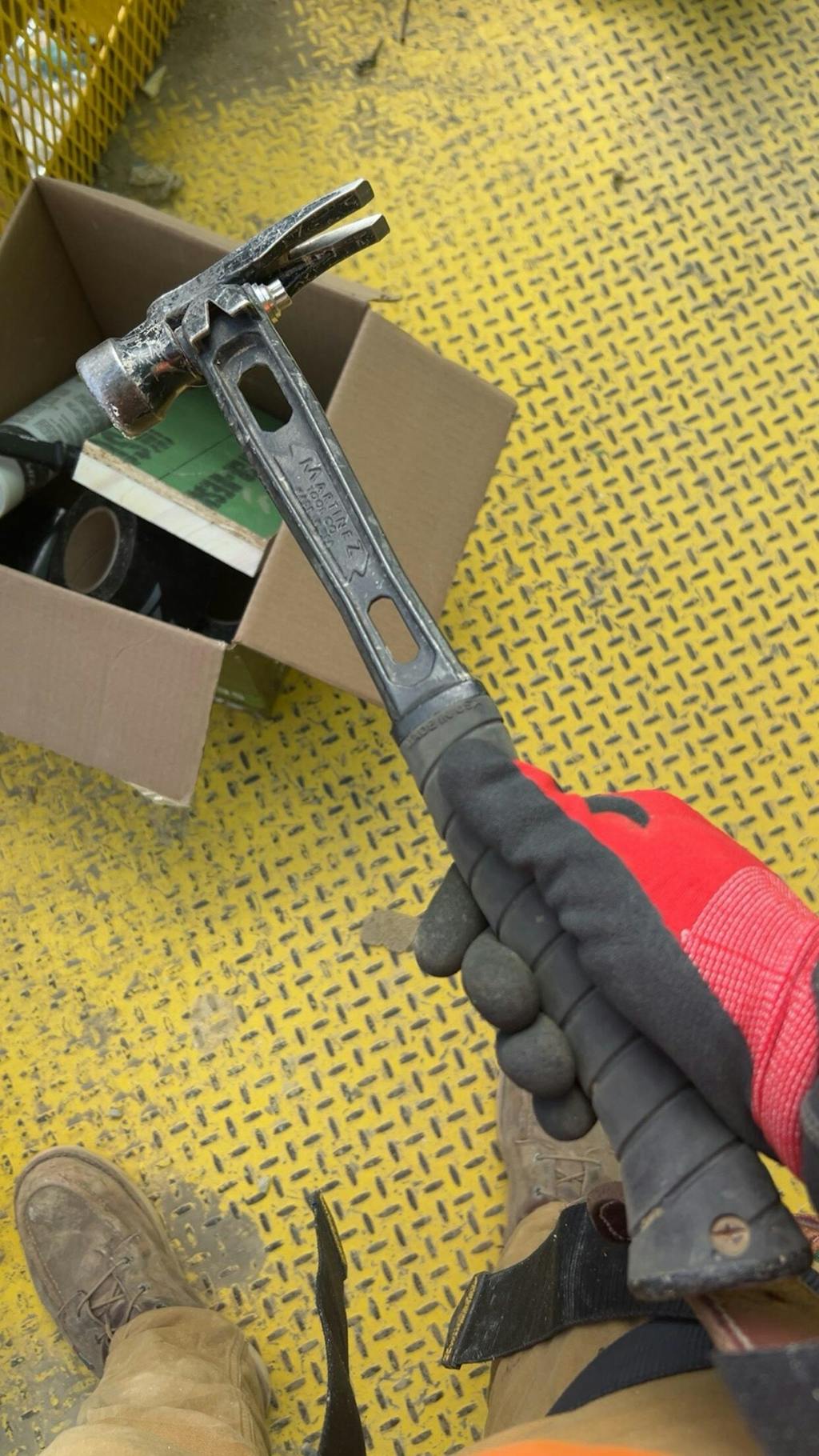
Different trades require different striking tools. Understanding hammer types means understanding their specific applications. Framing Hammers are built for driving large nails into structural lumber. Features include heavier heads (20-32 oz for steel, 12-16 oz for titanium), longer handles for increased leverage, straight or curved claws for pulling framing nails, and aggressive face patterns for better nail grip. Used primarily in framing, decking, and heavy construction. For framers who need maximum driving power with less fatigue, the M1 is the purpose-built answer. Browse our M1 framing hammers to find the right configuration for your structural work.
Finishing Hammers
Designed for trim carpentry and detail work. Lighter heads (12-16 oz) provide control, smooth faces prevent surface marking, curved claws facilitate delicate nail removal, and shorter handles offer precision. Used for installing molding, cabinetry, and finish materials. Finish carpenters need precision over power, and the M4 is built specifically for that kind of work. Browse our M4 finishing hammers to find the right configuration for trim, molding, and detail applications.
Dead Blow Hammers
A hollow head filled with steel shot or sand that prevents rebound. Used for assembly work, setting joints, and applications where follow-through striking could damage materials. Not typically used for fastener driving.
The Framing Hammer: Built For Heavy-Duty Job Site Work
Framing hammers are the workhorses of construction sites. They're engineered to drive large fasteners into structural lumber efficiently and withstand the punishment of daily professional use.
What Makes a Framing Hammer Different
Framing hammers feature heavier heads (typically 20-32 oz for steel, 12-16 oz for titanium) and longer handles (14-18 inches) that generate maximum striking force. The face is often textured with a waffle or grid pattern that grips nail heads and prevents glancing blows. The claw geometry varies between straight and curved designs. Straight claws provide additional prying capability, while curved claws offer better leverage for pulling framing nails.
Waffle Face Vs. Smooth Face
Waffle-face framing hammers have a textured striking surface that grips nail heads and reduces slippage. This design increases driving efficiency but leaves distinctive marks on wood surfaces, making them unsuitable for finish work. Smooth-face framing hammers work for both structural and exposed applications where surface appearance matters. They require more accuracy but won't mark the material.
When to Choose a Framing Hammer
Use a framing hammer for structural work: wall framing, floor systems, roof framing, deck building, and any application involving 16d nails or larger. The added weight and striking power significantly reduce the number of swings required per fastener. If you're driving nails into dimensional lumber or engineered wood products, a framing hammer is the right choice.
The Finishing Hammer: Precision Over Power
Finishing hammers prioritize control and surface protection over raw striking force. They're designed for applications where appearance matters and damage is unacceptable. The lighter head weight (12-16 oz) provides better control for precision work. Smooth faces prevent marking on finished surfaces. Curved claws facilitate delicate nail removal without damaging the surrounding material. Shorter handles (12-14 inches) offer improved accuracy in tight spaces.
Why Smooth Faces Matter in Finish Work
A smooth striking face distributes impact evenly across the nail head, leaving no texture marks on the wood surface. This is critical when installing trim, molding, or cabinetry, where every surface mark shows in the finished product. Smooth faces require greater precision but deliver clean results that don't require additional surface preparation or repair.
Applications for Finishing Hammers
Finishing hammers are used for installing baseboards, crown molding, door and window casing, cabinet assembly, furniture building, and any trim carpentry where appearance matters. They're also appropriate for small fastener work where a framing hammer's weight would be excessive and difficult to control.
Balancing Weight and Control
The ideal finishing hammer weight depends on the work. Lighter hammers (12-14 oz) offer maximum control for delicate applications. Slightly heavier finishing hammers (14-16 oz) provide more driving power for hardwoods and larger trim fasteners while maintaining adequate control.

Hammer Comparison Guide: How To Match The Tool To The Trade
Choosing the right hammer means understanding your primary applications and working conditions. Different trades have different requirements:
Framing and Structural Work
- Primary tool: Heavy framing hammer (20-32 oz steel, 12-16 oz titanium)
- Face style: Waffle or milled for structural work, smooth for exposed framing
- Handle length: 16-18 inches for maximum leverage
Framers benefit from heavier tools that reduce the number of swings per fastener. The additional weight pays off in increased efficiency over long shifts.
Finish Carpentry and Trim Work
- Primary tool: Finishing hammer (12-16 oz
- Face style: Smooth to prevent surface marking
- Handle length: 12-14 inches for control in tight spaces
- Claw type: Curved for delicate nail removal
Finish carpenters need precision over power. Lighter tools provide better control and reduce the risk of overdriving fasteners or damaging materials.
General Carpentry and Remodeling
- Primary tool: Mid-weight hammer (16-20 oz)
- Face style: Smooth for versatility
- Handle length: 14-16 inches for balanced performance
- Claw type: Curved for general nail pulling
Remodelers and general contractors benefit from versatile tools that handle both structural work and finish applications. Mid-weight hammers offer acceptable performance across applications without requiring multiple specialty tools.
Grip And Handle Materials: Comfort On The Clock
Handle design directly affects comfort, control, and fatigue during extended use. Material choice matters as much as head design. Hickory and ash handles offer natural shock absorption and a traditional feel. Wood handles can be replaced when damaged, making them economical for rough use. They require proper maintenance and may loosen over time in variable humidity conditions. Wood handles provide excellent feedback and are preferred by many traditionalists, but they're less durable than modern materials in harsh job site conditions.
Steel Handles: Maximum Strength
One-piece steel construction eliminates the possibility of handle failure. Steel handles are the most durable option, but transfer the most shock to the user. They're typically reserved for specialty applications where durability is the primary concern. Most steel-handled hammers include rubber or polymer grips to improve comfort, but they still transmit more vibration than other handle materials.
Grip Design and Ergonomics
Handle shape affects control and comfort during extended use, and the right grip geometry can make a noticeable difference across a full shift. Watch our comparison of curved vs straight hammer grips to understand which option best suits your working style and hand position. Textured or rubberized surfaces prevent slippage in wet or sweaty conditions. Grip diameter should match hand size; too large reduces control, too small causes hand fatigue. Professional-grade tools feature ergonomic designs that distribute pressure evenly across the palm and reduce stress on joints during extended use.

Final Thoughts
Understanding hammer types and matching the right tool to your trade improves efficiency and work quality while reducing fatigue. Framing hammers deliver striking power for structural work. Finishing hammers provide precision for trim applications. The differences aren't cosmetic; they're functional requirements. Handle materials, grip design, and balance affect how you feel at the end of a long shift. These factors matter as much as head weight when you're using a hammer hundreds of times daily.
Martinez Tools was built by someone who understood what tradesmen actually need from the tools in their belt. Read about the legacy of Mark Martinez and the values that continue to shape every hammer we build.. We focus on durability, balance, and real-world functionality because those are the characteristics that matter on job sites. Our tools are engineered for specific applications and manufactured to last through years of professional use. The right hammer makes the work easier, produces better results, and holds up under pressure. Choose tools built for your trade.
Frequently Asked Questions About Different Hammer Types
What are the different types of hammers used for?
Framing hammers drive large fasteners in structural work. Finishing hammers handle trim and detail carpentry. Ripping hammers are for demolition. Dead blow hammers prevent rebound in assembly work. Each type is designed for specific applications and materials.
How do you choose the right hammer?
Match head weight to your primary work: heavier (20-32 oz steel) for framing, lighter (12-16 oz) for finish work. Choose a face style based on surface requirements: textured for structural work, smooth for finished surfaces. Consider handle material for comfort during extended use.
What are the 10 types of hammers?
Framing, finishing, ripping, trim, claw, ball peen, sledge, dead blow, club, and drywall hammers. Each serves specific trades and applications. Construction professionals typically need framing hammers for structural work and finishing hammers for trim applications.
Which type of hammer is best?
The best hammer matches your trade and primary applications. Framers need heavy striking power. Finish carpenters need precision control. There's no universal "best," only the right tool for the specific work you perform most often.
How many types of hammers are there in carpentry?
Carpentry primarily uses four hammer types: framing hammers (20-32 oz steel, 12-16 oz titanium) for structural work, finishing hammers (12-16 oz) for trim, trim hammers (14-16 oz) for general installation, and ripping hammers for demolition. Specialty applications may require additional types.
What hammer type is best for beginners?
A mid-weight (16-18 oz) smooth-face hammer with a curved claw provides versatility for general carpentry. It's heavy enough for basic framing but light enough for controlled finish work. This allows beginners to handle multiple applications while developing proper technique.