Key Takeaways:
- Match the hammer to the job. Weight, face pattern, claw style, and handle length all affect speed, accuracy, and fatigue. Using the wrong hammer costs you time and energy.
- Professional hammers outperform budget tools over time. Better materials, stronger connections, and precision construction mean less wear, fewer replacements, and a lower real cost per year.
- Titanium reduces fatigue; steel offers feedback. For high-volume framing, titanium handles win on endurance. For precision finish work, many tradesmen prefer steel's direct feel.
How many times have you watched a guy grab the wrong hammer and fight his way through a job that should've taken half the time? The difference between types of hammers isn't academic; it's the gap between finishing framing by lunch and still swinging at 3 PM.
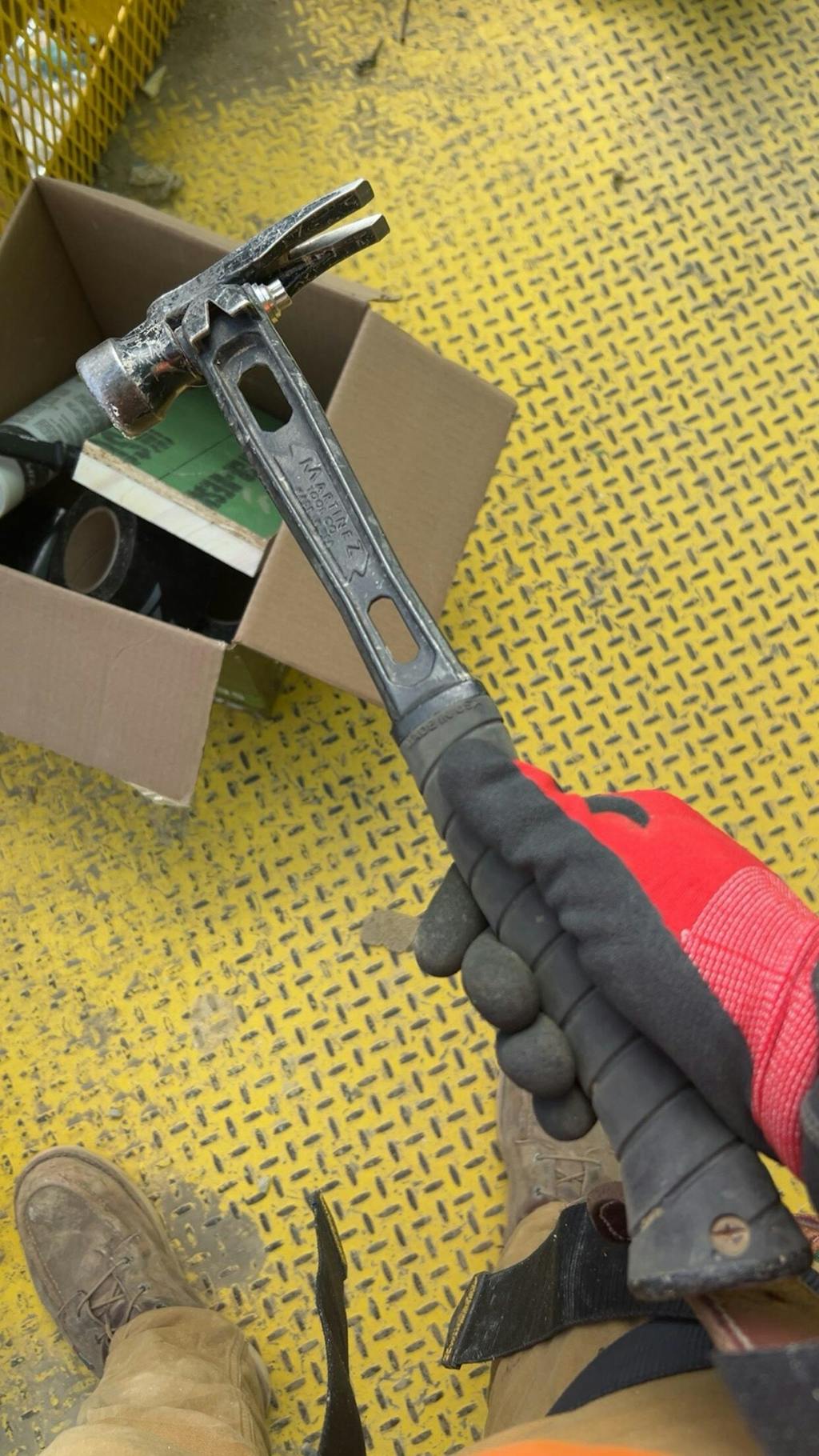
At Martinez Tools, we build professional-grade hammers for tradesmen who know the difference. From titanium framing hammers to precision finish hammers, every tool we make is engineered for a specific purpose because we understand that the right hammer in the right hand changes how the whole job goes.
In this guide, we're breaking down different types of hammers, what separates framing from finishing tools, and how to match the right hammer to the work you're doing without wasting time or energy.
What Every Tradesman Should Know
Not all hammers are built the same. The weight, balance, face design, and claw configuration affect how the tool performs and how your body feels after a full day of work. Every trade has its demands, and matching the right hammer to your specific work starts with understanding what each configuration is built for. Watch our guide on which Martinez hammer is right for me to find the head weight, handle, and face that fits your trade and daily applications.
Weight Classification
Hammer weight determines driving force and user fatigue. Framing hammers typically run 20–28 oz for maximum impact per swing. Finishing hammers sit at 14–16 oz for controlled, precise strikes. Heavier doesn't always mean better; it means different applications.
Face Design
Milled faces (waffle pattern) grip nail heads and reduce glancing blows during framing. Smooth faces prevent marring on finished work. The wrong face can damage material or slow you down. Head design is where performance starts, and understanding what goes into a precision-engineered head helps you evaluate what you're actually holding. Watch our video on all about Martinez custom hammer heads to see how our head engineering delivers consistent control and striking efficiency on the job.
Handle Material and Length
Wood handles offer traditional feedback but break under abuse. Fiberglass absorbs shock but can loosen over time. Steel and titanium handles last longer and maintain structural integrity. Handle length affects leverage and swing mechanics; longer handles increase power but reduce control in confined spaces.

Framing Hammer Vs. Finishing Hammer: What's The Actual Difference
Framing and finishing hammers solve different problems. Framing hammers run 20 to 32 ounces and drive large nails with fewer swings. Finishing hammers range from 12 to 16 ounces, prioritizing control over raw power. You can't efficiently drive 16-penny sinkers all day with a finish hammer, and you can't set delicate trim without denting it using a framing hammer. Framing hammers use milled, or waffle faces that bite into nail heads and prevent glancing strikes. Finishing hammers feature smooth faces that won't mark trim or leave textured impressions on finish surfaces. The face pattern directly determines whether you're gripping or protecting.
Claw Style for Material Removal
Framing hammers typically have straight claws optimized for prying apart structural lumber and pulling large nails with maximum leverage. Finishing hammers use curved claws designed to extract finish nails from trim without damaging the surrounding wood. Different geometry for different removal tasks.
Handle Length and Swing Arc
Longer handles on framing hammers (typically 15-18 inches) create more swing speed and driving force. Shorter handles on finish hammers (12-14 inches) improve precision and control in tighter spaces around trim and cabinetry. Length affects both power and accuracy, depending on the application.
How To Match The Right Hammer To The Right Job
Using the wrong hammer slows you down and increases fatigue. Matching the tool to the task is straightforward once you understand what drives the decision:
Match Weight to Nail Size and Volume
Driving 16-penny nails in framing lumber all day requires a 24-28 oz hammer to minimize strike count and maintain pace. Setting 6-penny finish nails in trim requires a 14-16 oz hammer to prevent overstriking and surface damage. Weight should match the resistance you're working against; too light means extra swings, too heavy means unnecessary fatigue on lighter tasks.
Choose Face Pattern Based on Material Sensitivity
Structural work where appearance doesn't matter takes a milled face that won't slip on nail heads during hard strikes. Finishing work on visible surfaces requires a smooth face that leaves no witness marks. If the surface is to be seen, don't use a textured face.
Consider Claw Type for Removal Needs
Jobs involving demolition or structural corrections benefit from straight claws that provide better prying leverage. Trim and finish applications where you're pulling small nails without damaging the surrounding wood, which need curved claws. If you're doing both types of work, you need both types of hammers; one tool can't optimize for opposite claw functions.
Factor Handle Material Into Repetitive Use
All-day framing work generates significant vibration, titanium and advanced composite handles reduce shock transfer and decrease arm fatigue compared to straight steel. Lighter tasks with fewer repetitions can use steel handles without the same fatigue penalty. Daily high-volume work justifies investing in vibration-dampening handle materials.
Account for Working Space and Access
Tight spaces around cabinets, trim corners, and confined framing areas require shorter handles for better control and clearance. Open framing on walls, decks, and roofs allows longer handles that generate more swing speed. Handle length should match the physical space you're working in.

What Separates A Professional Hammer From A Hardware Store Special
The gap between professional-grade hammers and consumer tools shows up under daily use, not on the shelf. Professional hammers use heat-treated alloy steels and titanium that maintain structural integrity through thousands of strikes. Budget hammers use softer metals that deform, crack, or lose temper under sustained heavy use. The difference appears after months of daily swinging when cheap hammer faces mushroom or handles fail at connection points.
Head-to-Handle Connection Engineering
Quality hammers feature epoxied and wedged connections designed to handle lateral stress and prevent head separation during side-load prying. Cheap hammers often rely on friction fits or minimal wedging, which loosen under job-site conditions. A separated head is dangerous and ruins productivity when it happens mid-job.
Weight Distribution and Balance
Professional tools balance the weight between the head and handle to reduce swing effort and improve accuracy. Poor-quality hammers lack balance, forcing you to fight the tool's momentum rather than using it efficiently. This imbalance compounds over hundreds of swings per day, causing earlier fatigue.
Face Geometry and Striking Consistency
Precision-milled striking faces provide consistent nail contact and reduce glancing blows. Mass-produced hammers often have inconsistent face geometry, leading to bent nails and wasted strikes. When you're driving nails all day, strike consistency directly affects output.
Handle Grip and Shock Absorption
Professional-grade handles incorporate materials and design features that reduce transmitted shock while maintaining a secure grip under sweaty conditions. Hardware-store hammers use basic rubber or vinyl grips that slip when wet and transmit more vibration to your hand and arm. Comfort matters when you're swinging for 8 hours.
Long-Term Performance Under Load
Quality hammers maintain performance characteristics, face condition, handle integrity, and claw strength through years of professional use. Budget hammers degrade rapidly under the same conditions, requiring replacement within months. The professional tool costs more upfront but delivers a lower annual cost per unit of service.
Titanium Vs. Steel Hammers
Material choice affects performance, durability, and how you feel at the end of the day. Some manufacturers claim that titanium hammers provide approximately 10 times the recoil damping of steel, significantly reducing cumulative stress on joints. Steel provides traditional feedback that some professionals prefer for precision control. Titanium delivers equal striking force at a lighter weight, reducing swing fatigue during high-volume work. Steel requires more mass to achieve the same impact energy. Both materials last under professional use when properly constructed. Steel scratches and dents more visibly but maintains function. Titanium resists surface wear better. Steel hammers cost less upfront. Titanium hammers cost more initially but potentially reduce long-term health costs and lost productivity from repetitive strain. Experienced tradesmen often prefer the material they learned with. Steel feels traditional and provides direct feedback. Titanium reduces fatigue and is well-suited to high-volume applications.
Which Martinez Hammer Belongs In Your Tool Belt
Every trade has its demands. Every job site has its conditions. The hammer you reach for should match both. Martinez Tools builds a focused lineup of professional-grade hammers, each one engineered for a specific type of work, a specific type of tradesman, and a specific standard of performance. Here's how to find yours:
The M1 15oz Framing Hammer
Built for heavy-duty construction. The M1 is the framer's hammer, 15 ounces of driving power with a titanium handle that cuts fatigue without cutting performance. Available in milled or smooth face, curved or straight grip, and a range of finishes, including the Freedom Fighter, Blue Halo, and Iron Man editions. If you're building a structure day in and day out, this is the tool for that work.
The M4 12oz Finish Hammer
Built for precision. The M4 gives finish carpenters and trim tradesmen the control they need, a lighter head, cleaner strikes, and the same titanium handle construction as the M1. Available in smooth, dimple, and wide-claw head configurations, with curved or straight grip options. When accuracy matters as much as speed, the M4 is the right call. For finish carpenters who need precision, clean strikes, and a lighter tool that won't over-drive fasteners, the M4 is the right answer. Browse our M4 finishing hammers to find the right configuration for trim and detail work.
The M79 Sledge Head Framing Hammer
Built for the tradesman who needs more. The M79 pairs a sled-style head with the M1 titanium handle and curved grip, a purpose-built tool for demanding applications where standard framing heads don't cut it. Available in the Signature Series and built to the same standard as every Martinez tool in the lineup.
The Signature Series
Every hammer above is available as part of the Martinez Signature Series, with titanium handles, steel heads, and your choice of grip, face, and finish. Pre-configured for performance and ready to work straight out of the box. No guesswork, no compromise.
Can't Find Exactly What You Need? Build It.
Martinez Tools offers a full custom hammer configurator. Choose your head, handle, grip, and finish, and get a hammer built to your exact spec, American-made, to the same standard as every tool we produce.

Final Thoughts
Not all hammers are created equal, and the difference between grabbing the right one and the wrong one shows up fast on the job site. Whether you're driving framing nails all day or setting delicate trim, matching the hammer to the task, in terms of weight, face, claw, and handle, directly affects your output, your accuracy, and how your body feels at the end of the shift. Martinez Tools was built on a foundation of firsthand trade experience and a commitment to making tools that actually perform on job sites. Read about the legacy of Mark Martinez and the values that continue to drive every tool we build. From the M1 framing hammer to the precision M4 finish hammer, every tool in the lineup exists to put the right instrument in the right hand, because that's what separates tradesmen who work smart from those who just work hard.
Frequently Asked Questions About Different Types Of Hammers
What are the different types of hammers?
Common types include framing hammers (20–28 oz, milled face), finishing hammers (14–16 oz, smooth face), rip hammers (general purpose), roofing hammers (with cutting edge), dead blow hammers (non-rebound), club hammers (masonry work), ball peen hammers (metalworking), and cross peen hammers (starting small fasteners). Each serves specific trades and applications.
Which type of hammer is best?
The best hammer matches your primary work. Framers need 20+ oz hammers with milled faces. Finish carpenters require 14–16 oz smooth-face hammers. General construction benefits from balanced rip hammers. There's no universal "best," only the right tool for your specific trade and application.
What type of hammer do carpenters use?
Carpenters typically carry both framing hammers (20–24 oz) for structural work and finishing hammers (14–16 oz) for trim and detail applications. Many also keep a general-purpose rip hammer for a variety of tasks. Professional carpenters often own multiple hammers and select based on the day's work.
What hammer type is best for beginners?
A 16–20 oz rip hammer with curved claw provides versatility for learning basic carpentry. Weight is manageable for developing proper swing mechanics while still driving common fasteners effectively. Avoid specialty hammers until you've identified your primary trade focus.
How many types of hammers are there in carpentry?
Carpentry primarily uses three types: framing hammers for structural work, finishing hammers for trim and detail, and general-purpose rip hammers for mixed applications. Specialty hammers like roofing or cross peen serve specific tasks but aren't daily-carry tools for most carpenters.
What hammer has 80% hammer power?
This likely refers to titanium hammers that manufacturers claim provide significantly greater recoil damping than steel hammers while delivering the same driving force. The claim relates to energy efficiency and reduced fatigue, not reduced striking power.