Key Takeaways:
- Start Smart, Not Cheap: Quality beginner carpentry tools cost more upfront but eliminate the need for replacements and perform better under pressure.
- Measure Twice, Cut Once: Accurate layout and measuring tools prevent costly material waste and rework on every project.
- Framing Demands Different Gear: A dedicated framing tools list includes heavy-duty equipment built to handle repetitive, high-impact work.
A carpenter is only as good as the tools in their belt. Show up to a job with the wrong setup, and you're improvising all day, slower, less accurate, and working harder than you need to. The right carpentry tools list doesn't just make the job easier. It makes the difference between work you're proud of and work you have to redo.
At Martinez Tools, we build professional-grade tools for tradesmen who know what belongs on a job site and what doesn't. From precision-balanced titanium hammers to specialty layout tools, every Martinez tool is designed to earn its place in your belt and stay there.
In this piece, we'll cover a comprehensive carpentry tools list spanning 25 must-haves, from essential measuring and layout tools to framing and fastening tools, broken down for every skill level so you know exactly what to reach for and when.
Why Every Carpenter Needs A Solid Tool Foundation
The difference between a carpenter who finishes jobs efficiently and one who struggles comes down to having the right tools within reach. Missing a critical tool mid-project costs time, creates workarounds that compromise quality, and adds unnecessary frustration to already demanding work. A solid tool foundation means owning equipment that handles 90% of common carpentry tasks without gaps. You're not buying everything at once; you're building a collection that grows with your skills and the complexity of jobs you take on.
Starting with quality foundational tools also protects your investment. Cheap equipment fails faster, cuts less accurately, and often needs replacement before you've finished your first major project. Professional-grade tools maintain performance through years of daily use.
Build Gradually Based on Job Requirements
Your carpentry tools list should expand as your work diversifies. Framing carpenters need different priorities than finish carpenters. Start with versatile tools that support multiple applications, then add specialized equipment as specific jobs demand it.
Quality Tools Reduce Fatigue and Improve Accuracy
Balance and weight distribution matter during eight-hour workdays. Poorly designed tools cause unnecessary strain, slow you down, and increase error rates. Tools engineered for extended use help you work longer without sacrificing precision.
The Right Tools Make Skilled Work Possible
Some techniques simply can't be executed without proper equipment. You can't cut accurate miters with a dull saw, frame walls quickly without a reliable nailer, or maintain tight tolerances using a tape measure that won't lock. Skills and tools work together; neither fully compensates for the other's deficiencies.

Beginner Carpentry Tools: Where To Start Without Overspending
Beginner carpentry tools should cover the basics: measuring accurately, cutting straight, and driving fasteners. Start with hand tools before investing in power equipment. Once you've developed skills and know what type of work you'll be doing long-term, add specialized gear.
Tape Measure
A 25-foot tape measure handles most residential and commercial work. Look for a standout of at least 7 feet and a durable blade coating that resists wear. The lock mechanism should hold under tension without slipping.
Speed Square
This triangle does more than mark 90-degree angles. Use it for rafter cuts, quick measurements, and saw guides. A 7-inch size fits in a tool belt and handles most framing tasks. A speed square earns its place in every carpenter's belt, and understanding what separates a precision layout tool from a basic angle guide matters for the work you do every day. Read our Martinez Rapid Square review to see how this tool performs across framing, rafter layout, and everyday carpentry applications.
Carpenter's Pencil
Flat pencils don't roll off surfaces. The wide lead marks are clearly on rough lumber. Keep several on hand; they disappear fast on jobsites.
Claw Hammer
A 16-ounce hammer works for general carpentry. The claw should pull nails cleanly without bending. Handle material affects grip and shock absorption; choose what feels balanced in your hand.
Handsaw
Circular saws are faster, but a quality handsaw cuts where power tools can't reach. A 15-inch blade with 8–10 teeth per inch handles crosscuts and rip cuts in framing lumber.
Utility Knife
Retractable blades, quick-change mechanisms, and a solid grip matter more than you'd think. You'll use this tool constantly for marking, trimming, and opening materials.
Chalk Line
Long layout work requires a chalk line. A 100-foot line covers most framing jobs. The reel should rewind smoothly, and the chalk reservoir should seal tightly to prevent spills.
Nail Set
Countersinking finish nails requires a nail set. A 3-piece set (1/32", 2/32", 3/32") covers most nail sizes. Steel tips resist mushrooming after repeated strikes.
Essential Carpenter Tools For Measuring And Layout
Accurate measurements prevent mistakes that cost material and time. Layout tools establish reference points, angles, and elevations before any cutting begins. Accurate layout starts with a square you can trust, and understanding what makes a precision layout tool different from a standard square helps you build a kit that performs. Watch our video on precision squares and micro squares to see how these tools support accurate layout across framing and finish applications.
Level
A 24-inch level works for most framing and layout tasks. Longer levels (48 inches) improve accuracy over greater distances. Vials should be easy to read, and the frame should resist twisting under pressure.
Combination Square
This adjustable square checks 90-degree and 45-degree angles. The ruler slides for depth measurements and layout marking. A quality combination square holds its settings without shifting.
Stair Gauge
The Martinez stair gauge clamps onto a framing square to set consistent angles for stair stringers, rafter cuts, and repetitive framing layouts. It locks tight and adjusts quickly for different pitches. Consistent angles for stair stringers, rafter cuts, and repetitive framing layouts depend on a gauge that locks tight and stays put through the work. Browse our stair gauges for precision layout tools designed to keep your repetitive angle work accurate and efficient.
Framing Square
A 16" x 24" framing square handles rafter layouts, stair calculations, and large-panel squaring. Look for clear markings and a rust-resistant finish.
Marking Gauge
This tool scribes parallel lines at consistent distances from an edge. Use it for mortise layouts, depth lines, and repetitive marking tasks where a pencil lacks precision.
Must-Have Carpentry Tools For Cutting And Shaping
Cutting tools make or break a project. Dull blades, underpowered saws, and poorly balanced hand tools slow you down and compromise accuracy.
Circular Saw
Most 7¼-inch circular saws can cut standard 2x lumber at 90 degrees, and many bevel to at least 45 degrees, though capacity varies by model. Corded models deliver consistent power for all-day framing. Battery-powered saws offer portability at the cost of runtime.
Jigsaw
Curved cuts, interior cutouts, and tight-radius work require a jigsaw. Variable speed control and tool-free blade changes improve efficiency. A sturdy base plate keeps cuts square.
Reciprocating Saw
Demo work, rough cuts, and cutting in place demand a reciprocating saw. Use it for plunge cuts, flush cuts, and removing material where precision doesn't matter.
Miter Saw
Crosscuts and angled cuts on trim, molding, and dimensional lumber require a miter saw. A 10-inch blade handles most residential work. Compound miter saws tilt for bevel cuts.
Block Plane
Shaving down doors, chamfering edges, and fine-tuning joints calls for a block plane. A sharp blade and adjustable depth setting give you control over material removal.
Chisels
A 4-piece set (¼", ½", ¾", 1") covers most mortising, paring, and cleanup work. Keep them sharp; dull chisels slip and require excessive force.

The Framing Tools List: What You Need To Build Structure
Framing work demands tools that handle speed, power, and repetitive tasks without failure. The framing tools list focuses on productivity and durability under continuous use.
Structural carpentry creates the skeleton that everything else attaches to. Mistakes here affect the entire project, so accuracy tools and reliable fastening equipment are non-negotiable.
Framing Hammer
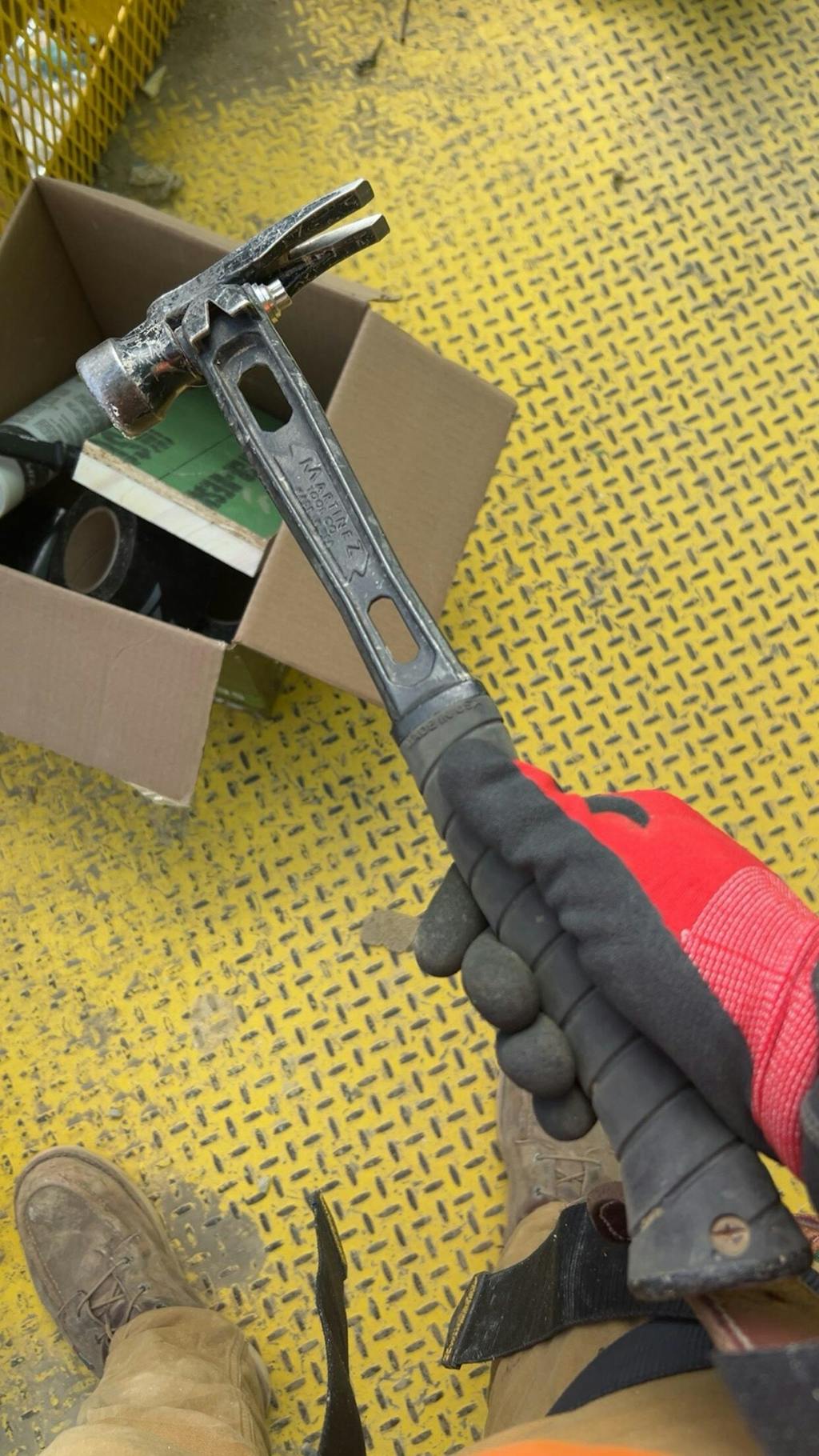
Framing hammers commonly have steel heads weighing 20–32 oz, typically a straight (ripping) claw, and often a milled or checkered face to reduce slipping on nail heads. The extra weight allows framing nails to be driven efficiently without excessive swings. We build titanium framing hammers that reduce weight while maintaining driving force, resulting in less fatigue over long days.
Pneumatic Framing Nailer
A pneumatic framing nailer typically drives 2" to 3-1/2" nails through multiple boards in a fraction of the time it takes hand-driving. It's the single most impactful productivity tool for framing work. Requires an air compressor and proper maintenance.
Cat's Paw Pry Bar
For pulling nails and gentle demolition, the Martinez Tools Titanium Finish Nail Puller gets under nail heads cleanly. Our titanium construction delivers full steel strength at reduced weight, giving you the leverage you need without the fatigue.
Wrecking Bar
A longer wrecking bar (24" to 36") handles heavier demolition and provides leverage for major disassembly work. Keep one in the truck for renovation projects and structural tear-out.
Tool Belt
A framing-style tool belt keeps fasteners, pencils, a tape measure, a speed square, and a hammer accessible while leaving both hands free. Both leather and heavy-duty synthetic (e.g., high-denier nylon) tool belts can be very durable; longevity depends more on material grade and build quality (stitching, rivets, reinforcement) than on material type alone.
Fastening And Driving Tools No Carpenter Should Be Without
Driving fasteners efficiently separates productive carpenters from those who constantly adjust, reload, or fix mistakes.
Impact Driver
An impact driver delivers rotational force for lag screws, structural screws, and long fasteners. Hex shank bits lock in place. Variable speed triggers prevent overdriving.
Drill/Driver
A ½-inch drill handles boring, driving, and mixing tasks. Keyless chuck speed bit changes. Two-speed gearboxes balance torque and speed for different materials.
Pry Bar
Titanium pry bars combine strength with reduced weight. Use them for demolition, board alignment, and separating nailed assemblies. Nail slots pull fasteners cleanly. Martinez pry bars are built to last through heavy daily use. For demo work, board alignment, and pulling stubborn fasteners, having a pry bar built for repeated professional use makes a real difference across a full day. Browse our titanium pry bars for lightweight, high-strength options built to handle daily prying without added fatigue.
Upgrade Your Workflow With Martinez Tool Co. Professional Gear
We build tools for professionals who depend on performance every day.
Our hammers, pry bars, and specialty tools are engineered for balance, durability, and real-world functionality. Every design decision comes from jobsite experience, not marketing departments. Materials are chosen for their performance under stress. Weight distribution is calculated to reduce fatigue during repetitive tasks.
Titanium Framing Hammers
Because impact energy depends on both head weight and swing speed, titanium hammers can help some users achieve comparable driving performance with less fatigue, especially during repetitive swings. Less swing fatigue. More control. Milled faces grip nails without slipping. Straight claws pull and pry without bending.
Titanium Pry Bars
Martinez titanium pry bars combine strength and reduced weight for all-day demo and framing work. Multiple nail slots accommodate a range of fastener sizes. The beveled edges fit into tight spaces without damaging surrounding material.
Martinez Stair Gauge
The Martinez stair gauge locks onto framing squares to establish consistent angles for stair stringers, rafter cuts, and repetitive layout work. Quick-adjust clamps hold tight without slipping. Use it beyond stairs; any project requiring repeated angles benefits from the precision.
American Craftsmanship You Can Rely On
We manufacture in the United States using precision machining and quality materials. These aren't disposable tools; they're designed to be kept, maintained, and relied on. Performance-driven design backed by American craftsmanship. Martinez Tools was built by someone who understood what tradesmen actually need from the gear in their belt. Read about the legacy of Mark Martinez and the values that continue to drive every tool and piece of gear we produce.

Final Thoughts
Building a complete carpentry tools list takes time and should match the work you're actually doing. Start with foundational measuring, cutting, and fastening tools that support multiple applications. Add specialized equipment as needed for your projects.
Quality matters more than quantity. Professional-grade tools maintain accuracy, withstand job-site conditions, and last for years of daily use. Calculate the cost per year of use rather than focusing solely on the initial price; durable tools cost less in the long run.
Match your tool purchases to your skill progression and the type of carpentry you perform. Framers need different priorities than finish carpenters. Beginners benefit from versatile tools that teach fundamental skills before investing in specialty equipment.
Martinez Tools builds gear for professionals who need performance they can rely on. No gimmicks. Just tools designed to last through years of hard use.
Frequently Asked Questions: Carpentry Tools List: 25 Must-Have Tools For Every Skill Level
What tools should every carpenter have?
Every carpenter needs a tape measure, speed square, hammer, handsaw, level, utility knife, and chalk line. Add a circular saw, a drill, and a nail gun, as budget allows.
What tools are required for a carpenter?
Required tools depend on the work. Framing carpenters need hammers, nail guns, circular saws, and layout tools. Finish carpenters need miter saws, chisels, block planes, and precision measuring equipment.
What tools are needed for any level of woodworking?
All woodworkers need measuring tools (tape measure, square), cutting tools (saw, plane), fastening tools (hammer, screwdriver), and marking tools (pencil, knife). Skill level determines tool quality and specialization.
What are the 10 common tools?
A tape measure, hammer, level, speed square, utility knife, circular saw, drill, screwdriver, handsaw, and chalk line are used on most job sites, regardless of trade or specialty.
What is the 5'7" rule in woodworking?
The 5'7" rule isn't a standard carpentry term. You may be thinking of the 3-4-5 rule for squaring corners: measure 3 feet on one side, 4 feet on another, and a 5-foot diagonal confirms a 90-degree angle.
What safety gear and personal protection equipment is essential when working with hand tools on the jobsite?
Wear safety glasses, work gloves, steel-toe boots, and hearing protection when using power tools. Dust masks prevent inhalation of sawdust and debris. Hard hats protect against overhead hazards on active jobsites.